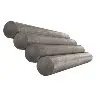
High temperature resistance:
The melting point of graphite is as high as 3850℃. It has excellent stability in high temperature environment and will not soften, melt or deform.
Corrosion resistance:
Graphite has good corrosion resistance to most acids, alkalis and organic solvents, and is suitable for corrosive environments in the chemical industry.
Good thermal and electrical conductivity:
Graphite materials have good thermal and electrical conductivity, can effectively conduct heat, reduce thermal stress, and improve processing efficiency.
Low thermal expansion coefficient:
Graphite materials have a low thermal expansion coefficient, good dimensional stability in high temperature environments, are not prone to thermal expansion and contraction, and maintain mold accuracy.
Self-lubricating properties:
Graphite has natural lubrication properties, which reduces friction between the mold and the processed material, prolongs the life of the mold, and improves processing efficiency and quality.
High mechanical strength and light weight:
Graphite materials can still maintain high mechanical strength at high temperatures, and are light in texture, making them easy to process and operate.
Good processability:
Graphite materials are easy to machine and can be processed into complex shapes and high-precision molds to meet various industrial needs.
Thermal shock resistance:
Graphite materials have good thermal shock resistance to rapid temperature changes and are not prone to cracks or breakage.
Environmental protection:
Graphite is an environmentally friendly material that does not contain harmful substances and meets the environmental protection requirements of modern industry.